Overview — why federal is a graph problem
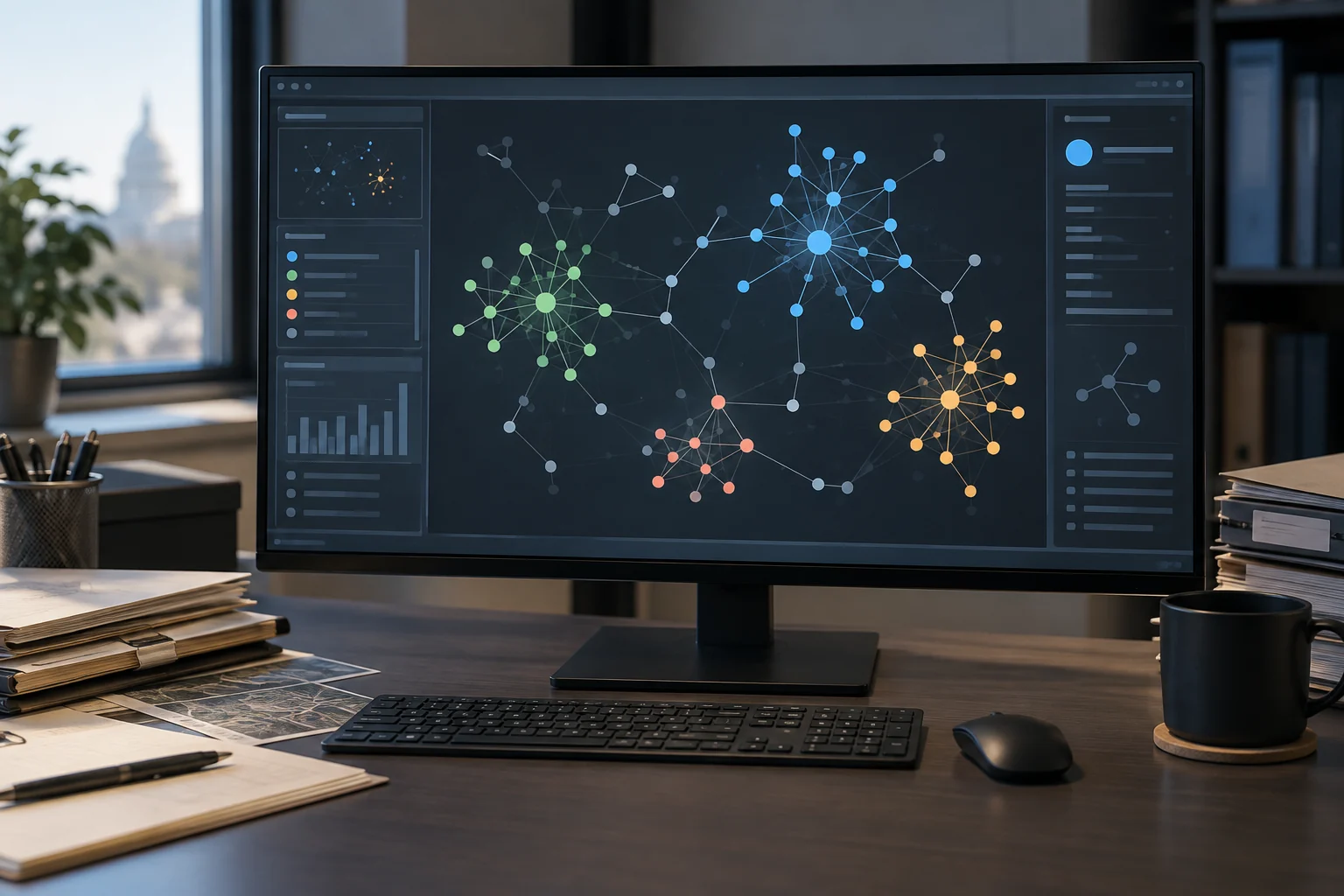
Most federal data is, at its core, a graph. Citizens connect to programs. Programs connect to funds. Funds flow to contractors. Contractors employ people. People travel between addresses. Vehicles register to addresses. Addresses sit in jurisdictions. Jurisdictions receive grants. The moment any analyst asks a question that traverses more than two of these relationships — "which contractors working on a DoD program have overlapping ownership with contractors excluded from HHS procurement?" — a relational join-heavy database starts buckling under its own query plan. A graph database answers in milliseconds what an analyst would otherwise wait minutes for, if the query even finishes.
Precision Federal builds federal graph systems end to end: ingestion, entity resolution, storage, query, ML, and analyst-facing UI. We are a SAM.gov registered small business (UEI Y2JVCZXT9HP5, CAGE 1AYQ0, NAICS 541512). Our graph engineering spans the full spectrum — from intuitive analyst investigation tools to industrial-scale graph ML on billions of edges.
FEDERAL GRAPH ANALYTICS USE CASES
Our technical stack
| Layer | Primary | Alternates | When we use it |
|---|---|---|---|
| Graph DB (property) | Neo4j 5.x Enterprise | Amazon Neptune, TigerGraph, Memgraph | Default for interactive analyst workloads. |
| Graph DB (RDF) | Amazon Neptune (RDF) | Stardog, GraphDB | When SPARQL / OWL reasoning is in scope. |
| Distributed graph | JanusGraph on Cassandra | GraphFrames on Spark | Multi-billion-edge analytic scale. |
| Entity resolution | Zingg + Splink | Senzing, custom PyTorch | Probabilistic matching with graph-based collective resolution. |
| Graph ML | PyTorch Geometric | DGL, GraphSAGE, Node2Vec | GNNs for classification, link prediction, embeddings. |
| Query | Cypher | Gremlin, SPARQL, GQL | Cypher default. Gremlin for Neptune property workloads. |
| Streaming ingest | Kafka + Debezium CDC | Kinesis, Flink | CDC from systems of record. |
| Visualization | Neo4j Bloom, Cytoscape.js | Linkurious, D3 force-directed | Analyst investigation UIs. |
| Graph data science | Neo4j GDS library | NetworkX, igraph, cuGraph | PageRank, community, centrality, path algorithms. |
| APIs | GraphQL + gRPC | REST (read-through), Cypher HTTP | Downstream application integration. |
Federal use cases
FBI investigative link analysis
entity, relationship, and timeline graphs across case files, electronic records, and public-records augmentation. FBI page.
DHS illicit-network discovery
trafficking, smuggling, and fraud-network surfacing from administrative records. DHS page.
HHS benefits integrity
Medicaid / Medicare fraud detection through provider-beneficiary-claim graphs. HHS page.
a federal health agency program linkage
cross-state substance use services network analysis, drawing on the federal health agency production ML patterns we have already shipped. .
Treasury / FinCEN financial-network analysis
suspicious activity reporting, beneficial ownership traversal.
DoD supply-chain graph
tier-N supplier visibility, single-source-of-failure discovery. DoD page.
VA provider-veteran-claim graph
community-care network analysis and fraud surfacing. VA page.
USDA farm-program graph
payment overlap and related-party detection across programs. USDA page.
NIH grants graph
researcher-institution-project networks for program evaluation.
GSA procurement graph
vendor, past-performance, award-protest, and exclusion networks.
Reference architectures
1. Entity resolution + graph warehouse in GovCloud
Source systems stream CDC events via Debezium into Kafka (MSK in GovCloud). A stream-processing job resolves entities with Splink (probabilistic matching) and applies deterministic overrides. Resolved entities land in an Iceberg-backed graph staging layer; a nightly load builds the canonical Neo4j graph. Analyst queries hit a Neo4j Enterprise cluster; ML queries hit an export in Neptune Analytics. Audit logs capture every query and every entity-resolution decision for reviewability.
2. Intelligence investigation portal in Azure Government IL5
A custom investigation UI fronts a Neo4j cluster on AKS IL5. Analysts see a Cytoscape-based graph canvas with lasso selection, ego-network expansion, and timeline reconstruction. Every graph mutation logged for attribution. Sensitive attributes masked unless the analyst's clearance and need-to-know permit. Export to i2 Analyst's Notebook for downstream briefing products.
3. Graph ML pipeline for fraud scoring
A heterogeneous R-GCN over a healthcare claims graph, trained in PyTorch Geometric on a SageMaker GPU instance. Nightly retraining on the last 18 months of claims. Inference produces a fraud-risk embedding for every provider; downstream rules convert embeddings to review priorities. MLflow captures every training run, every data slice, and every evaluation metric.
Delivery methodology
- Discovery — graph hypothesis: what question, what entities, what edges, what sources. Agree on success metrics (queries/sec, entity-resolution F1, analyst time-to-insight).
- Design — schema, identifier strategy, ingest plan, security zones, query patterns, UI workflows.
- Build — increments: raw ingest → ER → canonical graph → first analyst workflow → ML overlays.
- Validate — ER quality review with subject matter experts; false-positive audit; pen test; ATO support.
- Operate — observability dashboards, backup/restore drills, graph rebalance runbooks, ongoing ER tuning.
Engagement models
SBIR Phase I / II fixed-price
ER prototypes, graph ML pilots.
Fixed-price pilot
scoped single-mission investigation portal.
T&M modernization
ongoing graph platform work.
OTA
DIU, NSIN, NavalX, AFWERX, Tradewinds.
Sub to prime
graph specialist inside a larger investigation or benefits integrity program.
Maturity model
Level 1 — Directory graph
single-source node-edge extraction.
Level 2 — Integrated graph
multiple sources unified with rule-based matching.
Level 3 — Resolved graph
probabilistic ER with confidence and provenance on every identity.
Level 4 — Analytical graph
ML overlays (embeddings, anomaly scores) consumed by analysts and downstream systems.
Level 5 — Operational graph
closed-loop with systems of record; graph insights drive real casework and measurable outcomes.
Deliverables catalog
- Entity and relationship schema (Arrows.app diagram + PlantUML export).
- Entity resolution pipeline (Zingg/Splink job + override rules).
- Graph load jobs (Cypher/openCypher LOAD or bulk importer).
- Graph database deployment (Helm charts, Terraform modules).
- Analyst UI (React + Cytoscape.js).
- GraphQL + gRPC APIs with OpenAPI / proto docs.
- Graph ML training and inference code (PyTorch Geometric).
- Observability dashboards.
- SSP appendix + control inheritance.
- ER quality audit workbook.
Technology comparison
| Platform | Strengths | Weaknesses | Federal fit |
|---|---|---|---|
| Neo4j Enterprise | Cypher, GDS library, Bloom, bolt protocol. | Licensing cost at scale, clustering operational overhead. | High — analyst-heavy workloads. |
| Amazon Neptune | GovCloud-native, managed, IAM-integrated, Gremlin + SPARQL. | Less analyst ecosystem, limited GDS-equivalent. | High — AWS-native programs. |
| TigerGraph | Distributed, fast multi-hop, GSQL. | Smaller federal footprint, GSQL learning curve. | Medium — large-scale analytics. |
| JanusGraph | Open source, distributed. | Operational complexity, slower innovation. | Medium. |
| Memgraph | In-memory, Cypher-compatible, streaming-first. | Smaller ecosystem. | Medium — streaming-heavy workloads. |
| Senzing | Turnkey entity resolution, strong accuracy out of the box. | Proprietary, limited tuning for novel domains. | Medium — quick ER wins. |
Federal compliance mapping
AC-3, AC-6, AC-16
attribute-based access control enforced at the graph API layer; sensitive edges filtered based on clearance / need-to-know.
AU-2, AU-3, AU-12
every query and every graph mutation logged with analyst identity, timestamp, and result size.
SI-4
graph-anomaly detection doubles as user-behavior-analytics for insider threat.
MP-4
entity-resolution decisions carry full provenance so analyst products can be audited and reviewed.
PT-4, PT-5
privacy impact assessment considerations documented for any graph touching PII.
Sample technical approach — benefits integrity graph
An HHS program office wants to surface potential over-billing networks in a claims dataset. Current state: SQL warehouse, 18-month analyst backlog, ad-hoc rule-based flagging.
Discovery: we define the graph — providers, beneficiaries, claims, addresses, phone numbers, bank accounts, NPI numbers. Sources: claims warehouse, NPPES, state licensure feeds, exclusion lists. Success metric: F1 on a held-out audit set and analyst time-to-first-lead.
Design: probabilistic matching on providers (Splink), deterministic matching on NPI. R-GCN for embedding; community detection via Louvain; pattern-based rules (e.g., suspiciously tight provider-address rings) via GDS.
Build: 12 weeks. Ingest → ER → graph → investigation UI → ML overlays.
Validation: 30-day shadow pilot with 4 auditors. Measured against their traditional queue.
Related capabilities, agencies, vehicles, insights
- Capabilities: Data Engineering, Machine Learning, Vector Databases, Full-Stack Development.
- Agencies: FBI, DHS, HHS, Treasury, DoD.
- Vehicles: SBIR, OTA, GSA MAS.
- Insights: Entity resolution patterns.
- .