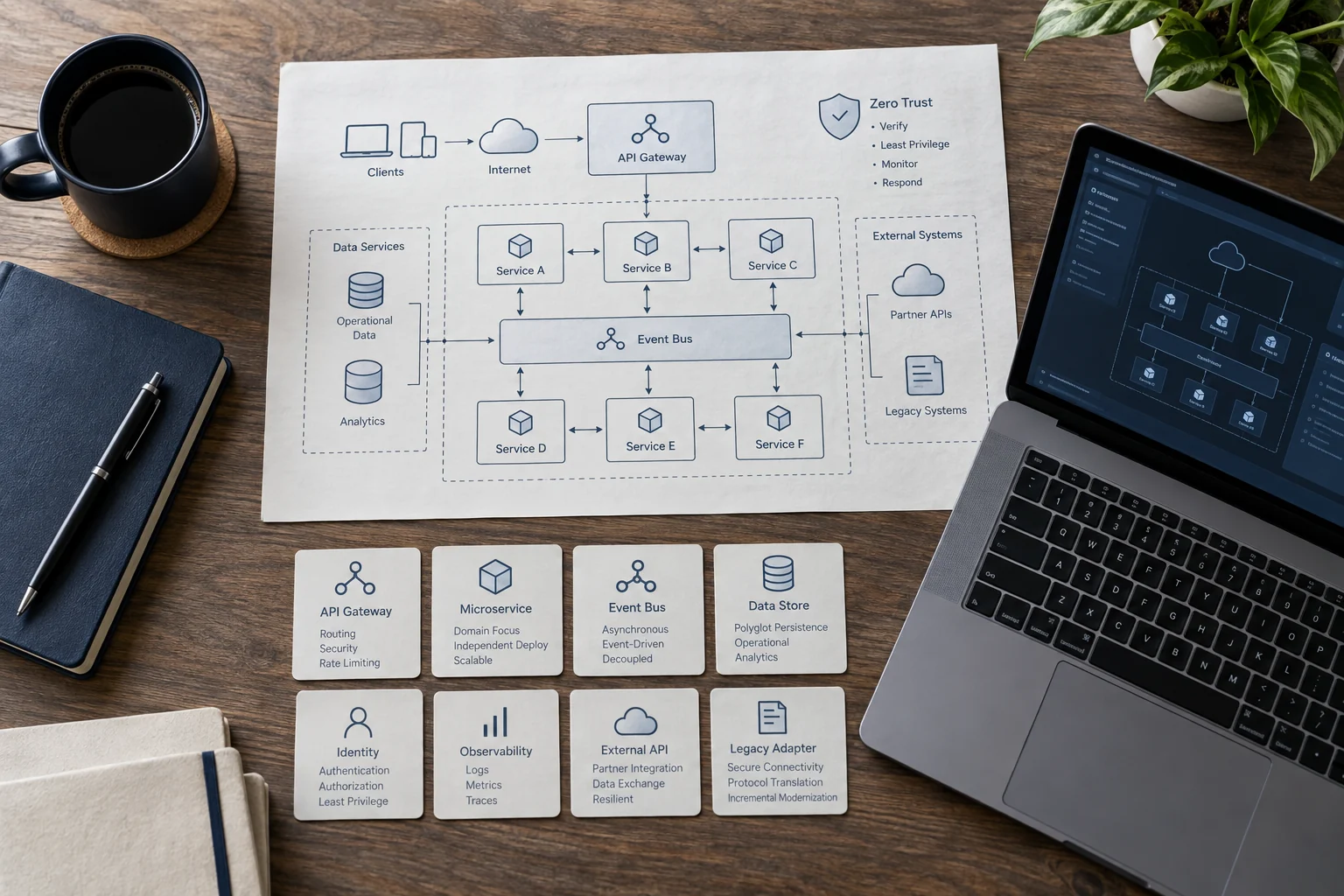
Architecture decisions outlive contracts
A federal system lives longer than the contract that built it. The architecture chosen in the first 90 days decides how the system will be maintained for the next 10 to 20 years, how easily it can be modernized by the next contractor, how it integrates with other agencies, and how it survives the inevitable budget pressure, reorg, and security review. Good architecture in a federal context is not the one with the most diagrams; it is the one that lets the next team do their job without rewriting the foundation.
Precision Federal approaches architecture as a series of honest trade-off decisions, documented in writing, visible to the team, and reversible where possible. We prefer boring technology, strong module boundaries, API contracts before implementations, and operational simplicity over theoretical elegance. We work against the government's actual risk model — audit, ATO, workforce turnover, integration with other agencies — and write architecture decision records (ADRs) the next team can read and understand.
Why this matters federally: most federal system failures are architectural, not coding. A well-coded monolith that cannot scale, an integration pattern that cannot survive a partner migration, a database schema that cannot support the new mission — these are architecture problems. Getting them right early is the highest-leverage federal technology investment a mission owner can make.
SOFTWARE ARCHITECTURE — FEDERAL APPLICATION FIT
The architectural toolkit we use
- Monoliths and modular monoliths: default for most greenfield systems. Clear module boundaries, clean dependency graph, and optional extraction paths to services later. See backend development.
- Microservices: Spring Boot, FastAPI, Go services, .NET minimal APIs. Service mesh (Istio, Linkerd) where mTLS and traffic policy matter. See microservices.
- Event-driven: Apache Kafka (self-hosted or AWS MSK), AWS EventBridge, Azure Event Grid/Hubs, RabbitMQ for simpler workloads. Outbox pattern for reliable publishing from relational systems.
- Streaming: Kafka Streams, Flink, Spark Streaming, Kinesis Data Streams/Firehose. Real-time analytics and ETL for federal data pipelines. See streaming data.
- API-first: OpenAPI 3.1 contracts, API gateways (Kong, Apigee, AWS API Gateway, Azure API Management), GraphQL federation where the client shape demands it. See API design.
- Federated identity: OAuth 2.1 / OIDC, SAML 2.0 where agencies still use it, login.gov integration for public-facing services, PIV/CAC for employee systems. See IAM.
- Zero trust: identity-aware proxies, service-to-service mTLS, workload identity (SPIFFE/SPIRE), policy as code (OPA/Rego). Aligns to OMB M-22-09 and CISA Zero Trust Maturity Model. See zero trust.
- Resilience patterns: circuit breakers (Resilience4j, Polly), bulkheads, timeouts, idempotency keys, saga coordination for distributed transactions.
- Documentation as code: ADRs in the repo (MADR template), C4 model diagrams via Structurizr, context/containers/components. Living docs regenerated on every build.
Patterns we apply often
A handful of patterns dominate our federal architecture work. Strangler fig for legacy modernization — a facade in front of the incumbent system, incremental replacement behind. CQRS plus event sourcing for systems that need auditable history (claims, cases, benefits). API gateway with backends-for-frontends when public web, mobile, and internal admin need different shapes of the same data. Outbox and inbox patterns for reliable cross-service messaging on top of relational databases. Hexagonal/ports and adapters for services whose business logic must outlive the framework of the day.
Federal deployment considerations
- ATO boundary alignment: architecture diagrams match the authorization boundary. Every component is in the boundary or has a documented trust relationship with it.
- Zero trust compliance: OMB M-22-09, EO 14028, CISA ZTMM. Identity, devices, networks, applications, and data each get a zero-trust posture documented in architecture.
- Integration across agencies: integrating with CMS, IRS, VA, SSA, and DHS systems requires adherence to each agency's interface control document and often an interconnection security agreement (ISA).
- Cloud portability: architecture should not hard-couple to a single hyperscaler where the agency has multi-cloud ambitions. We abstract at the seams (object storage, queue, identity) and use Terraform modules to keep patterns consistent.
- Cost and FinOps: architecture decisions drive cloud spend. We model run-rate cost during design and revisit as traffic grows.
Where this fits in Precision Federal engagements
Architecture is the spine of every engagement. It pairs with backend development, API design, legacy modernization, and cloud migration. Typical engagements: design a target-state architecture for a modernization effort, author ADRs and C4 diagrams for an ATO package, review an incumbent architecture and deliver a remediation roadmap, or embed as architect on a federal program across a multi-quarter build.